The Operating System for a Studio of One
AI made execution cheap, even for a team of one. Managing multiple projects at that speed is what got hard. So I built a system that surfaces it all to me every morning.
Before AI, my organization system was a roll of paper. It sat off to the left on my desk in an IKEA holder, and every morning I drew a line, stretched fresh paper out to the right, and wrote the date. All day, notes went straight onto the paper next to the laptop. At the end of the day I carried what was still open back to the left. At the end of the week I tore off the roll and read it back for anything worth keeping. It worked. It was also a lot of paper.
Now every morning a plan is waiting for me. Three things ranked, a short list of things deliberately not today, and a note admitting what the ranking ran on. I didn’t write it. Claude, the agent I build with, wrote it, from a page that knows all my projects, what phase each is in, and the open items across them.
Working with an AI agent, speed was the one thing I had too much of. Every session was fast, and every session started from zero. And it was never one session. On a normal day I have four or five agents running at once, on different projects or different corners of the same one, none of them aware of what the others are doing. In July a comp went out with an accent stripe on a card, a move I’d banned weeks earlier. The ban existed, in a file that session never read. Decisions I’d already made got made again because nothing but me remembered to bring them into the room. Projects drifted while my attention was elsewhere. The agent could build anything and remembered nothing, and I was becoming the memory, the router, and the referee for a teammate that outpaced me by ten to one.
Clarity creates speed. I’ve said that in enough conference rooms and Zoom calls that I should have seen it coming at my own desk. The agent was never the bottleneck. My own clarity was. What it needed from me was direction, memory, and taste, written down where a stateless collaborator could find them every time.
Registry
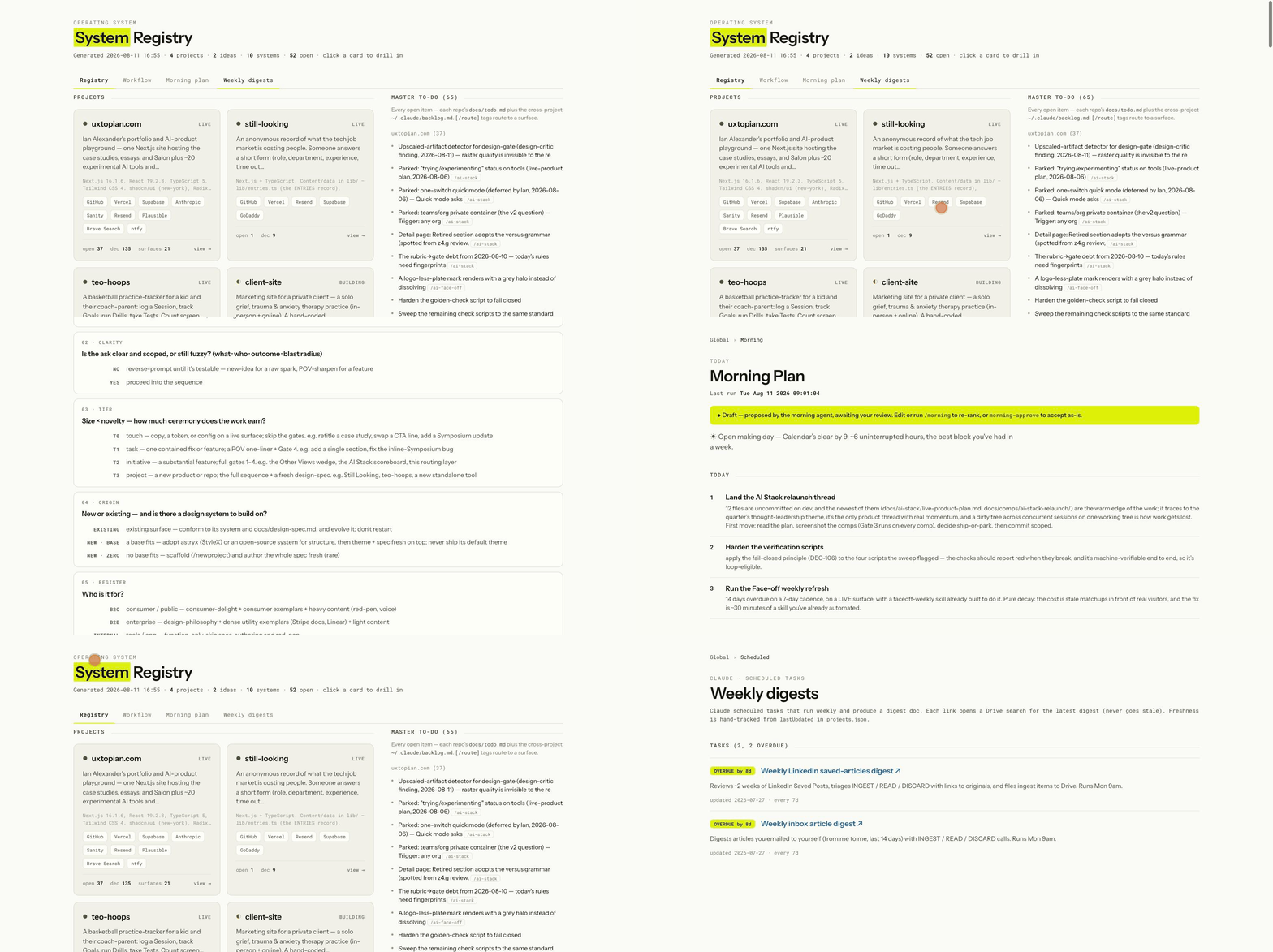
The system registry is the front door of a small operating system I’ve been building for my own practice. One command reads every project’s brief, decision log, and to-do list straight from the repos and rolls them up. Multiple projects, ten external services, every open item routed to the surface it belongs to. Click a card and you’re inside that project, looking at its phase, its decisions, and its open items. Nothing on the page is hand-written. If the page is wrong, a repo is wrong.
The obvious move for holding it all was a project tracker. But a tracker is another thing I have to remember to do. So the system is mostly boring files. Every project keeps a one-page brief that says what it is and what phase it’s in. Every project keeps a decision log. The biggest one is 135 entries deep, and each entry exists so a call gets made once instead of weekly.
Workflow
The workflow is the brains of the operation, the decision tree every piece of work walks before it earns any build time. It starts with six questions about the work. Whose is it, mine or a client’s? Is the ask clear enough to test? How much ceremony does it earn? Is there a design system to build on? Who is it for? What shape does it ship in? The answers build nothing on their own. They decide which of eleven phases fire, and how hard, from raw idea through ship.
Five gates stand where the mistakes get expensive. A point of view before any layout. Scope before any build. A wireframe screenshotted and judged before real code. Production code designed to a spec instead of a vibe. And fresh eyes attacking a screenshot of the finished thing before it ships. A one-line copy fix earns almost none of that ceremony. A new product earns the whole run. The gates automate the checks around the thinking, and the checks were the part I was worst at remembering to do. The stripe that shipped in July can’t ship again. A gate now checks every push and blocks it.
Speed was the one thing I had too much of.
Morning plan
The morning plan cross-references the registry with my calendar and a focus file, ranks the day into a top three, and then does the two things I’d want from a chief of staff. It names what it decided I shouldn’t do today, and it flags when its own inputs are thin. Last week it told me my focus file was 22 days stale and that the ranking was running on inference instead of intent.
Most of my day is now capture and routing. With five agents moving, thoughts arrive faster than they can be acted on, and anything I try to hold in my head is gone by the time a session finishes. So the system has a capture command. I type #gtd and a line, from any session, mid-anything, and the thought lands on the global list the registry reads. Three seconds, and the idea survives the multitasking. It’s the paper roll again, except this one reads itself back to me the next morning. That’s the part AI actually moved to the center of the workflow. The tasks run themselves now, and the systems thinking is mine.
Weekly digests
The week gets the same treatment the roll did. Everything I starred or emailed to myself, everything I saved on X and LinkedIn, gets summarized and compiled into one digest that’s waiting for me Monday morning, without my asking. The week itself gets graded too. How my loops ran, how my prompting held up, and where to improve, with suggestions that come from Claude and from the content I saved. The Friday paper tear-off became a tab.
None of it is impressive as software. Markdown, a couple of generator scripts, and a page that rebuilds from the sources in about four seconds.
The lesson transfers past a studio of one. A single person with an agent hit the clarity ceiling within weeks. A team of forty hits it harder and blames the tools. The fix is organizational. Write down what each thing is for, where decisions live, and what done looks like, in a place both the humans and the machines read. The building is cheap now. Build the clarity that builds the product. My system still draws a line every morning, still carries the open things forward, still tears off the week and reads it back. It works. And it’s a lot less paper. The old rolls start the grill now.
Highlight any sentence and three thinkers weigh in.
Ian Alexander
Design leader & design engineer — writing on leadership, AI product strategy, and building teams that ship.